Verzenay - Montagne de Reims

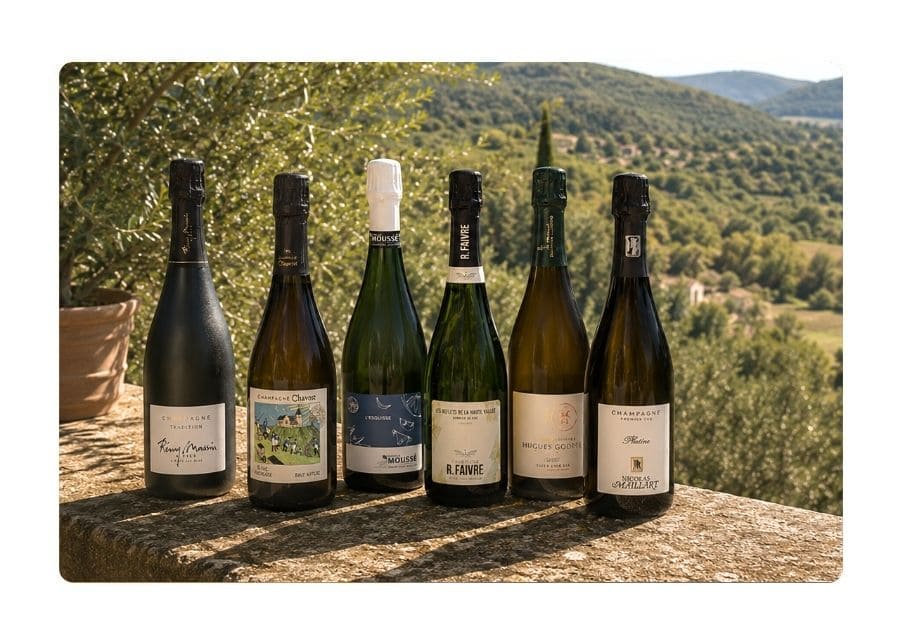
Champagne Hugues Godme

In Verzenay, Hugues Godmé has crafted a vision of champagne based on biodynamics and the purest expression of each terroir. Today, his daughter Lucille continues this journey across Verzy, Verzenay, Villers-Marmery, and Ville-Dommange. 

Precise and vibrant champagnes, where each cuvée offers a distinct interpretation of the Montagne de Reims.

Learn more

Active filters

Order directly from the winemaker

Cultivating Life

Long before biodynamics became a widely discussed topic in Champagne, Hugues Godmé questioned his approach to vine cultivation and the role he wished to give to living organisms.

Over the years, observation and experimentation became increasingly important in his work, eventually leading the estate towards organic farming and then biodynamics. The first certified organic harvest took place in 2013, followed by Biodyvin certification in 2014. Hugues often summarised this approach with a simple idea: "cultivating life."

Now retired, he has passed the reins to his daughter Lucille.

Four Villages to Tell the Story of the Montagne de Reims

Lucille has a remarkable canvas spread across four villages, each with its own distinct character: Verzy and Verzenay in Grand Cru, Villers-Marmery and Ville-Dommange in Premier Cru.

Pinot Noir, Chardonnay, and Meunier encounter diverse exposures and soils here, providing the estate with a true mosaic of possibilities.

The Pinot Noir from Verzenay and Verzy can thus be isolated in a Blanc de Noirs, while the Chardonnay from Villers-Marmery and Ville-Dommange finds its own expression in a Blanc de Blancs.

Each vine like a garden

This diversity underscores the central role of observation.

Biodynamics is not seen as a uniform recipe to be applied, but as a way to better support each vine and its environment.

This philosophy is reflected even in the vocabulary of the estate, with cuvées evoking "Gardens" and "Bouquets."

Some blend several villages and vintages, while others gradually narrow the focus to a single plot, grape variety, and harvest.

Rosé de macération or Coteaux Champenois further extend this exploration, allowing the terroir to be observed from another perspective.

Let the wine find its balance

In the cellar, the same freedom prevails. Wood plays a significant role without being systematic, with the proportions of barrel fermentation varying according to the cuvées, while fining and filtration are avoided. Dosages are low, with many champagnes offered as Brut Nature, and ageing can extend over several years, up to more than eight years for certain Vintages.

The result is a range that defies a single style: sometimes mineral and taut, sometimes deep and fleshy, but always crafted to reveal the differences between grape varieties, villages, and years.

It is now up to Lucille to continue this highly personal interpretation of the Montagne de Reims.