Champagne Hugues Godmé – Exclusive!

Offer ends in : 

Days
Hours
Minutes
Seconds

The Hugues Godmé Offer

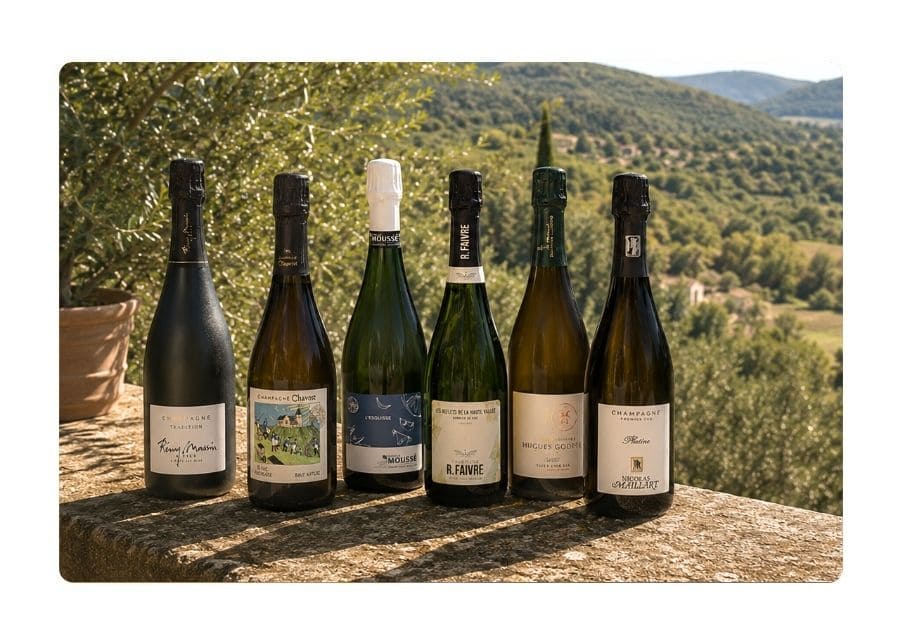
For one week only, Champagne Hugues Godmé is coming to Champagne Terroir! A range designed for both food pairing and tasting, characterised by extended ageing, partial barrel ageing and Brut Nature dosages. All of this reflects a philosophy deeply rooted in respect for nature, with the estate certified organic since 2013.

A sought-after estate with very limited quantities, too small to be part of our year-round range.

So we’re doing things differently: one week of pre-orders to give you access to these rare cuvées, at the best online price! Important information: orders will be shipped a few days after the pre-order ends, around 7 October.

Learn more about the estate

Cuvées at the Best Price!

Free Delivery

From 12 bottles anywhere in the UK!

Best Online Price

No crossed-out prices, just the best price!

Limited-Time Offer

Until 27 September at 11:59 PM!

Sébastien’s Pick

Head of Selection

Hugues Godmé… A must-have for any good Champagne merchant, a historic figure in biodynamics at a time when even organic viticulture was still keeping a low profile in Champagne, and a name inseparable from Verzenay.

I could start like that, but that’s not really what makes me want to tell you about him.

With Hugues Godmé, we enter a world of Champagnes with character – the kind that have a real personality.

The vast majority of the range is Brut Nature. That’s Hugues’s choice, and now Lucille’s too. There’s no compromising: they work with what the terroir gives them. So yes, we’re going to talk about power. In Verzenay, that’s nothing new – it’s almost a classic. But power alone has never been enough to make a great bottle.

So why Hugues Godmé rather than someone else? Because of more than ten years of organic and biodynamic viticulture? Because of his parcel-by-parcel approach, adopted long before everyone started talking about it? Because he chose to work with oak barrels before it became fashionable?

A little of all that, yes. Champagne is where a terroir, a winegrower and their vision come together. But if I’m bringing you these wines today, it’s above all because they’re good.

For me, Hugues Godmé is a snapshot of each terroir. Champagnes without artifice, with plenty to say without being pretentious. You can take your time tasting them, explore each individual parcel and discuss what the ageing brings. But you can just as easily open a bottle with friends, simply for the pleasure of it, without having to give a lesson on Champagne.

And that matters to me. A Champagne can be excellent while still being easy to enjoy. At the table, during a tasting, or simply because you felt like drinking a good bottle.

So yes, this time the name is probably already familiar to you. But I still really wanted to pour you a glass.

The Hugues Godmé Estate

In Verzenay, Hugues Godmé has developed a vision of Champagne based on biodynamics and the purest possible expression of each terroir.

Today, his daughter Lucille continues this journey across Verzy, Verzenay, Villers-Marmery and Ville-Dommange.

Precise, vibrant Champagnes, with each cuvée offering a different interpretation of the Montagne de Reims.

Pinot Noir, Chardonnay and Meunier grow across different exposures and soils, giving the estate a true mosaic of possibilities.

The Pinot Noir from Verzenay and Verzy can thus be expressed in a Blanc de Noirs, while the Chardonnay from Villers-Marmery and Ville-Dommange finds its own expression in the Blanc de Blancs.

The same freedom prevails in the cellar. Oak plays an important role without being used systematically, with the proportion of barrel fermentation varying from one cuvée to another, while fining and filtration are avoided. Dosages are low, many Champagnes are released as Brut Nature, and ageing can extend over several years – more than eight years for certain vintages.

The result is a range that is difficult to define by a single style: sometimes mineral and taut, sometimes deep and full-bodied, but always crafted to reveal the differences between grape varieties, villages and vintages.