Contact us | Who are we ?
Language
Favoris
Cart
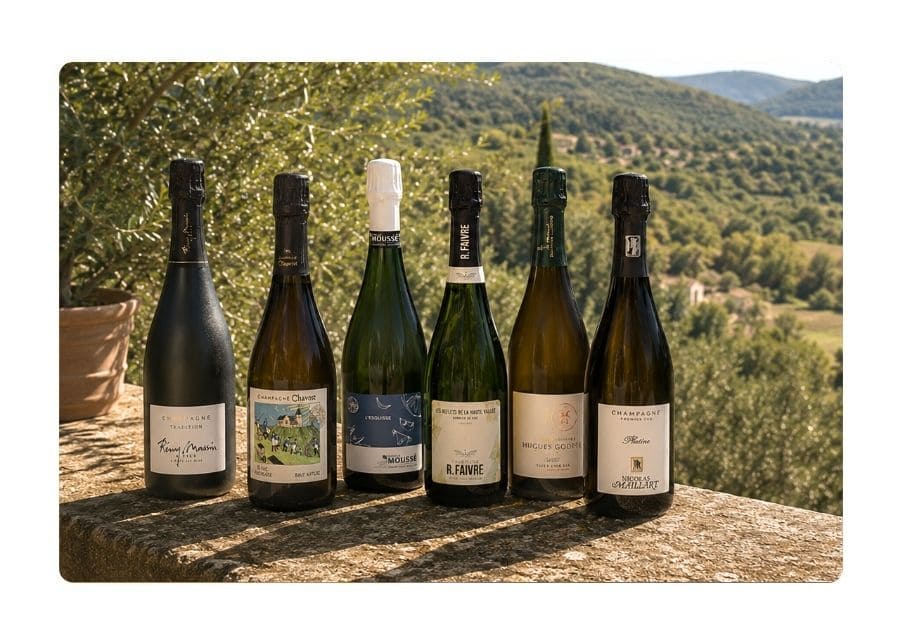
Moving away from traditional green bottles, some winegrowers now choose to use clear bottles for certain cuvées in their range. More modern and elegant, these “white” bottles showcase the wine’s colour, its reflections and the visual identity of the cuvée.
Discover our selection of Champagnes in clear bottles, chosen as always for their tasting qualities and distinctive character.
L'Arrogante 1er Cru
Fleur de Chardonnay vintage 2023
Rosé
Blanc de blancs harvest 2021
Rose Grand Cru
Cuvee A blanc de blanc
Rose
La Romane Pinot Blanc blanc de blanc
Rosé Grand Cru
Persin blanc de blanc
As you have probably already noticed, Champagne bottles come in several different shades. The most traditional and recognisable remains the famous green bottle.
Originally, however, this colour was not a deliberate choice. In the past, the glass used to make bottles contained more impurities, naturally giving it a green or amber tint. Over time, producers realised that this colour offered a real advantage when it came to preserving wine.
As a living product, wine is particularly sensitive to the conditions in which it is stored, especially light. Tinted bottles therefore gradually became the standard as a way of protecting the wine over time.
When wine is exposed to light for too long, a fault known as “lightstrike” can develop. This phenomenon permanently alters the wine and can produce unpleasant aromas. Once the wine has been affected, the damage is irreversible.
Thanks to its green tint, the glass filters out a significant amount of light, helping to preserve the Champagne’s aromas, freshness and balance.
For aesthetic reasons, but also to emphasise the visual identity of certain cuvées, a number of winegrowers now use clear bottles.
This choice is particularly common for Rosé Champagnes, as it allows the wine’s colour and its subtle shades to be fully appreciated. Many Blanc de Blancs Champagnes have also followed this trend, particularly to highlight their pure, bright and elegant character. Today, some winegrowers are taking this approach even further by using clear bottles for other cuvées in their range, either to reinforce their identity or give them a more modern style.
While highly attractive, these bottles require a little more care when it comes to storage. As clear glass offers less protection from light than a traditional green bottle, these Champagnes should be stored away from light.
Clear bottles often catch the eye when given as a gift or placed on the table. More modern and distinctive than traditional green bottles, they showcase the colour of the Champagne and create a striking visual presence at a meal or reception.
They are therefore particularly popular as gifts, for festive meals or special occasions where the appearance of the bottle becomes part of the overall experience.
However, the bottle itself does not affect the quality of the wine, so these Champagnes can be enjoyed on any occasion. And, like all Champagnes available from Champagne Terroir, these cuvées are selected first and foremost for their tasting qualities.
Like all Champagnes, clear bottles should be stored horizontally, away from light, in a cool place with a stable temperature, ideally between 10 and 15°C.
Clear bottles are often used for specific or more elaborate cuvées, such as certain Blanc de Blancs, Blanc de Noirs, vintage Champagnes or Champagnes from Grand Cru terroirs. The price therefore depends mainly on the style of the cuvée, the production requirements and the positioning of the Champagne, rather than on the bottle itself.
No, the colour of the bottle has no direct impact on the quality of the Champagne. It is mainly an aesthetic or marketing choice. Quality depends on the terroir, the winemaking and the winegrower’s expertise.
Yes. Beyond the classic green, some bottles may be slightly tinted or amber-coloured depending on the producer’s choices. There are also bottles covered with a sleeve, an opaque film that completely covers the glass and allows the design to be fully customised.
No. Not all Rosé Champagnes are bottled in clear glass. Some producers choose this type of bottle for aesthetic reasons, allowing the wine’s colour to be showcased. The choice mainly depends on the image the producer wants to convey.
No. They offer the same level of resistance: all Champagne bottles are designed to withstand pressure.
check_circle