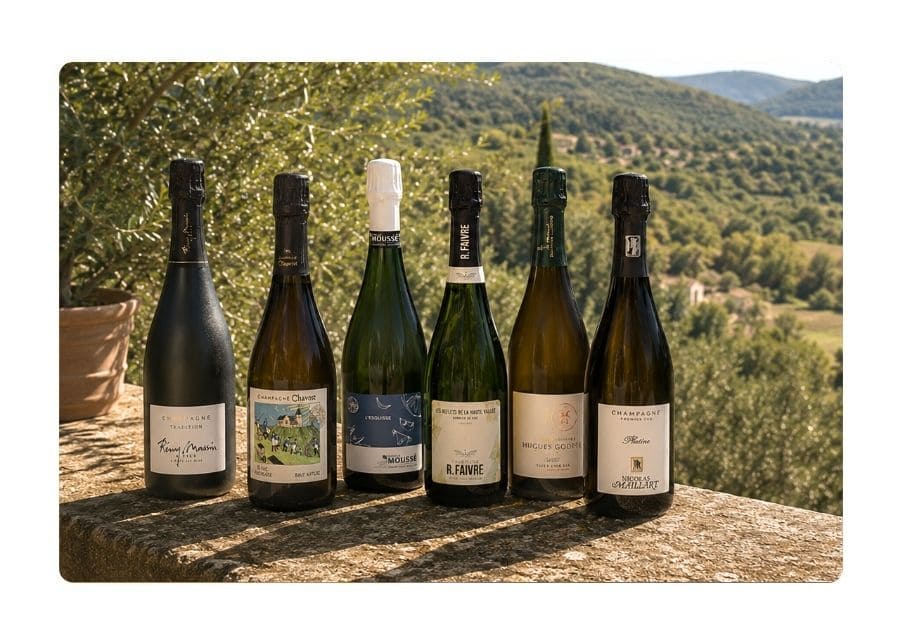
Exclusive ✨ Champagne Chavost, 100% no added sulphites at the Best Price
Contact us | Who are we ?
Language
Favoris
Cart
Champagne is, above all… a wine. This statement often comes as a surprise, as collective imagination immediately associates Champagne with its bubbles, celebration and effervescence. Yet before becoming a sparkling wine, Champagne is first and foremost a wine from the Champagne region, made from grapes grown, vinified and blended according to precise rules, like any great wine.
This misunderstanding between “wine” and “champagne” is common. Many people still contrast still wine and Champagne, even though they share the same viticultural and oenological origins. To truly understand what Champagne is, we need to go back to its roots: Champagne wine, also known as vin clair, the essential base of every bottle of Champagne.
At Champagne Terroir, we make it a point to highlight this often overlooked reality: Champagne is the result of a long winemaking process, well before the bubbles appear.
Contrary to popular belief, Champagne has not always been a land of sparkling wine. Until the 17th century, the region produced exclusively still wines, mostly red and sometimes white, intended to rival the great wines of Burgundy.
The cool climate, chalky soils and northern latitude gave rise to clear, taut wines with marked acidity. These wines, sometimes unstable, would naturally begin fermenting again in the spring following winter, initially giving rise to effervescence by accident.
This phenomenon, long perceived as a flaw, gradually became a defining signature. But originally, Champagne wine was not sparkling: it was vinified, tasted and sold as a still wine.
The Benedictine monk Dom Pérignon did not “invent bubbles” as is often said, but rather contributed to improving the quality of Champagne wines: grape selection, more precise blending, and better control of fermentation.
The great houses and the most demanding winemakers all share this philosophy: to craft a great wine before crafting a great Champagne.
This also explains why some Champagnes age so well: because they are built on a true wine structure.
Even today, before any secondary fermentation, every Champagne is first a still wine from the Champagne region, known as vin clair. These wines are vinified after harvest, grape variety by grape variety, plot by plot, village by village.
They are tasted, analyzed, sometimes aged in tanks, barrels or casks, and then blended. This work on the base wine is fundamental: if the wine is not good, the Champagne will never be.
Some winemakers even go further by producing still Champagne wines under the Coteaux Champenois appellation (red, white or rosé). These rare wines highlight one essential point: Champagne is, above all, a great wine-growing terroir.
The difference between a wine from Champagne and Champagne itself does not lie in the grapes, but in the production process.
Once the vin clair has been made and blended, the winemaker decides whether to:
• keep it still → Coteaux Champenois
• or transform it into a sparkling wine → Champagne
To do so, the wine undergoes a second fermentation in the bottle, thanks to the addition of the liqueur de tirage (wine + sugar + yeast). This fermentation naturally creates carbon dioxide, trapped in the bottle, giving rise to the bubbles.
Champagne is therefore not a “transformed” wine, but a finished wine, enhanced by time and the secondary fermentation.
Talking about “Champagne wine” also helps explain why Champagnes can have such different styles. It all starts in the glass… before the bubbles.
A vin clair made from Pinot Noir will bring more structure and depth.
A vin clair predominantly made from Chardonnay will bring tension and finesse.
A vin clair aged in barrels will develop a fuller, more vinous texture.
This is why some Champagnes are described as:
• vinous
• gastronomic
• suited for the table
• or, on the contrary, very crisp and ideal as an aperitif
Putting wine back at the heart of the Champagne narrative helps to:
• better understand styles
• make more informed choices
• better appreciate grower Champagnes
• reconnect with the notion of terroir
It is also a way to move away from purely marketing-driven discourse and return to what truly matters: Champagne, often reserved for special occasions due to its reputation, actually has its place in everyday life—especially when it comes to grower Champagnes, which are more accessible and authentic.
At Champagne Terroir, we select Champagnes first and foremost for their quality as wines: balance, personality, expression of terroir, and their ability to pair with a meal—not just an aperitif.
A wine produced in the Champagne region before the secondary fermentation, also known as vin clair. It can remain still or be intended to become Champagne.
Yes. Champagne is a sparkling wine, made from a base wine vinified like a traditional still wine.
Coteaux Champenois are still wines from Champagne, marketed as such, without undergoing secondary fermentation.
Because its quality first depends on the work in the vineyard and the winemaking process, before any effervescence.
Yes. There is no Champagne without a base wine.
It depends on the grape variety, ageing, terroir, and the winemaker’s style during the vinification of the vin clair.
check_circle