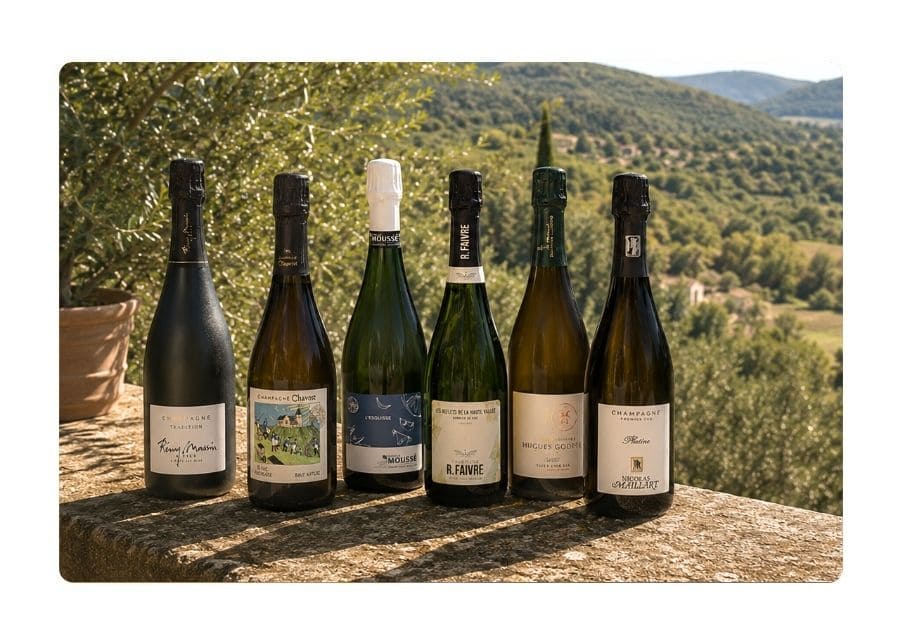
Exclusive ✨ Champagne Chavost, 100% no added sulphites at the Best Price
Contact us | Who are we ?
Language
Favoris
Cart
Blending lies at the heart of Champagne’s identity. Unlike many still wines, Champagne is most often the result of blending multiple grape varieties, parcels, villages, or vintages. This unique practice ensures balance, consistency, and complexity, while respecting the style sought by the winemaker.
At Champagne Terroir, we offer a wide selection of blended Champagnes, true reflections of Champagne know-how and each producer’s vision.
Blending consists of combining different base wines before the second fermentation. These wines may come from different grape varieties, terroirs, or vintages, notably through the use of reserve wines.
Historically, blending became essential in Champagne to cope with climatic variability. It made and still makes it possible to smooth out differences from one year to another and to produce balanced, consistent Champagnes. Even today, it remains the standard for the majority of non-vintage cuvées.
Champagne blending is primarily based on three grape varieties:
- Pinot Noir: structure, power, depth
- Pinot Meunier: fruitiness, roundness, richness
- Chardonnay: freshness, finesse, tension
Each winemaker works with these grapes like an aromatic palette. A blend dominated by Pinot Noir will result in a more structured Champagne, while a higher proportion of Chardonnay will bring freshness and elegance. Pinot Meunier, often underestimated, is essential for its fruity character.
Contrary to popular belief, a blended Champagne is not a “standard” Champagne. On the contrary, it is a true signature of a house or a winemaker.
The goal is not to erase character, but to seek balance: between freshness and maturity, between tension and richness. Blended Champagnes are often the most versatile, able to suit many tasting occasions and a wide range of food pairings.
They also represent the most faithful expression of a producer’s style, as they are reproduced and adjusted year after year.
The House of Krug is a perfect example of a Champagne built on the art of blending. Some cuvées incorporate reserve wines that are over ten years old. The objective is clear: to preserve a strong house signature, ensure great consistency from one year to the next, and express a unique identity, supported by a vast and remarkable library of reserve wines.
In non-vintage Champagnes, blending often includes reserve wines from previous years. These wines bring complexity, maturity, and consistency to the style of the cuvée.
Depending on the winemaker’s philosophy, reserve wines may represent 10%, 30%, or sometimes even more of the blend. Stored in tanks, barrels, or in a solera system, they play a key role in the balance and consistency of the Champagne. The solera system is based on a perpetual reserve principle, where wines from different years are continuously blended, with the oldest contributing their complexity to the younger ones.
It is thanks to them that a Brut Champagne can maintain a stable identity while evolving subtly over time.
Today, blending is evolving with changing consumer expectations. Winemakers are seeking greater precision, clearer expression of terroir, and enhanced freshness. Blends are often more refined, with lower dosage levels, allowing the wine’s natural character to shine through.
Climate change is also influencing blending decisions. As grapes ripen more naturally, winemakers adjust the proportions of grape varieties and reserve wines to preserve balance and drinkability.
At the same time, some producers are exploring single-parcel or single-varietal cuvées, but blending remains the backbone of Champagne and a cornerstone of its identity.
Blended Champagne is the most versatile of all. It is perfectly suited when you are looking for a balanced, approachable, and easy-to-enjoy Champagne.
It is ideal for aperitifs, especially during events or receptions, as it easily pleases a wide range of tastes. It is also an excellent choice for wedding receptions, family meals, or large gatherings.
At the table, a good blended Champagne pairs well with fish, seafood, white meats, and certain cheeses. Its balanced structure allows it to complement dishes without overpowering them, while bringing freshness.
Finally, it is the safest choice when offering a bottle or when you are unsure of your guests’ preferences.
Examples of food pairings with blended Champagne:
Champagne Bérat Schenk - Tradition Brut, for an aperitif or a wedding reception
Champagne François Chaumont – Blanc de Noirs Extra-Brut, with roasted poultry or a convivial dish
Champagne Nicolas Maillart – Platine 1er Cru, at the table with refined savory dishes
A Champagne made from multiple grape varieties, terroirs, or vintages, blended before the second fermentation.
No. It is actually at the heart of Champagne expertise and the foundation of the finest cuvées.
A vintage Champagne comes from a single year, while a blend can combine several years thanks to reserve wines.
To ensure balance, consistency, and the expression of the winemaker’s style.
A brut blended Champagne is the safest and most versatile choice.
check_circle