New ✨ Our Limited Edition boxes: Grand Cru, Blanc de Blancs and Blanc de Noirs
Contact us | Who are we ?
Language
Favoris
Cart
Unlike Bordeaux or Loire wines, champagnes are not wines from châteaux or localities, but rather wines from communes. The term Grand Cru or Premier Cru thus refers to the communes where the grapes used in the blend of the champagne you are about to taste are grown.
The Champagne AOP is not, contrary to what one might imagine, a geographically homogeneous area and is therefore not made up of a single block. The AOP is divided into 4 main zones: the Montagne de Reims, the Vallée de la Marne, the Côte des Blancs and the Côte des Bars. These large terroirs hide an extreme diversity of Champagne soils, so there are some 17 terroirs nested in these four large regions.
The most appreciated of these terroirs are generally those with a maximum of limestone outcrops on the surface. As we can see, it can be particularly complex to find your way among this multitude of soil characteristics. This is how the idea of classifying vineyard plots according to the quality of the grapes produced on the hillsides emerged at the beginning of the 20th century.
Obviously, the Champagne Grand Cru appellation is reserved for champagnes assembled exclusively from grapes from the best vines in Champagne.
The Grand Cru classification is the highest appellation in the AOC classification scale. Only winegrowers who have all of their vines in one or more villages classified as Grand Cru can have this mentioned on the label of their champagnes. And for good reason, out of the approximately 300 villages in the AOP, only 17 villages throughout Champagne can claim to be Grand Cru villages. This prestigious appellation was established due to the quality of the grapes from these vines, but also according to certain criteria of slope and exposure of the hillsides.
All of the plots classified as Grand Cru are located in the Marne department and are divided between three terroirs: the Montagne de Reims, the Vallée de la Marne and the Côte des Blancs.
The second major champagne appellation is of course that of Premier Cru. Once again, this appellation only designates a limited number of communes, 44 in total. Unlike the Grands Crus, Premier Cru champagnes can be produced in the departments of Marne, Aisne, Aube, Haute Marne and Seine et Marne. The rest of the Champagne vines are not classified.
Much more than a guarantee of provenance, these classifications constitute the consecration of a Champagne terroir recognized for the exceptionality of its natural conditions. But let's not forget that if a good grape is the basis of the winemaker's work, it is during the blending in the vat room that the aromas of the grapes will be revealed. The quality of the bunches is only one step towards the making of a good Grand Cru or Premier Cru champagne.
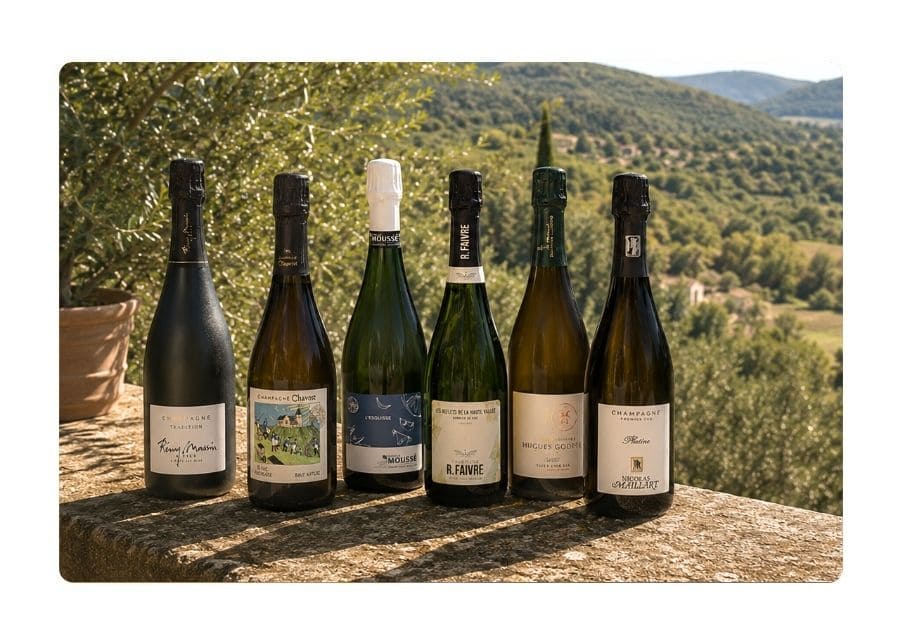
Promoting the expertise of independent winegrowers is the foundation of our project. Therefore, it seems normal to offer our customers the chance to discover great Champagnes from the best plots of Champagne. Despite the extreme prestige of these two appellations, Grand Cru and Premier Cru champagnes do not always enjoy great popularity due to lack of communication.
Many of us are unaware of the meaning of such appellations. In addition, many large houses are content to indicate the name of the village where their champagne is produced, leaving the connoisseur the leisure to appreciate the quality of the terroir where the grapes originate.
Many of us are unaware of the meaning of such appellations. In addition, many large houses are happy to indicate the name of the village where their champagne is produced, leaving the connoisseur the leisure to appreciate the quality of the terroir where the grapes originate.
Tradition 1er Cru
Brut blanc de blanc 1er Cru
Unique 1er Cru
Trilogie Extra Brut 1er cru
Sensation 1er Cru
Trilogie Brut 1er cru
Platine 1er Cru
Authentic'A 1er Cru
check_circle