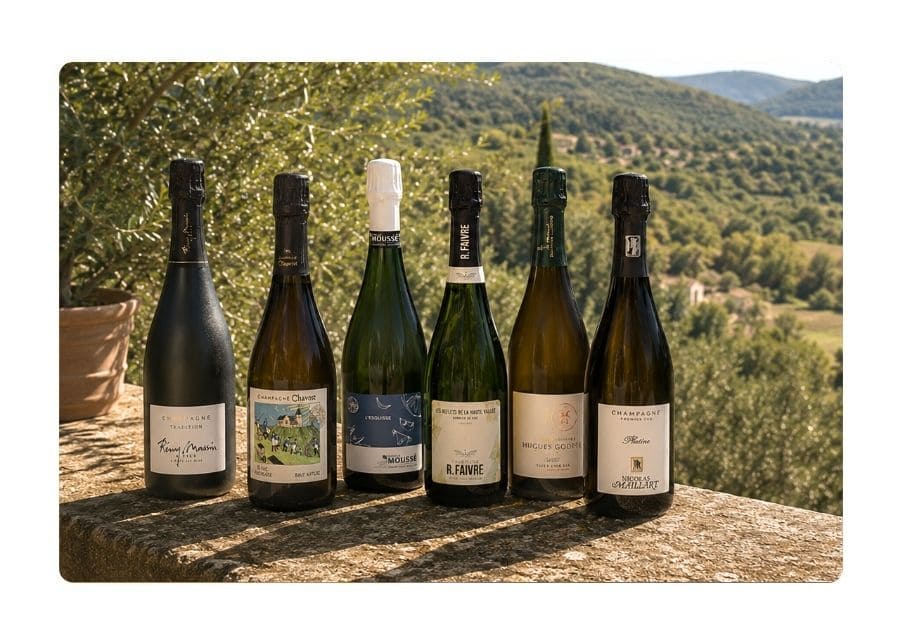
Exclusive ✨ Champagne Chavost, 100% no added sulphites at the Best Price
Contact us | Who are we ?
Language
Favoris
Cart
The Appellation d'Origine Contrôlée (A.O.C.) Champagne was created in 1927. It covers 34,000 hectares of vineyards in five départements: Marne, Aube, Aisne, Haute Marne and Seine-et-Marne. Champagne is known around the world and immediately evokes quality and luxury. However, champagnes are produced and distributed differently, which has a major influence on price.
A Champagne House doesn't grow its own grapes, but buys them from winemakers. It then handles vinification and packaging. Popular brands come from champagne houses, especially when they produce large quantities. They skilfully blend different grape varieties to create cuvées that they distribute on a large scale.
Winemakers grow, harvest and vinify their own grapes. They handle production from start to finish. The distribution of their champagne is much more confidential, and their brands are less known. You won't find these bottles in local shops, but only at a few wine stores and online.
There are 16,000 winegmakers and 320 champagne houses.
The quality of a winemaker's champagne is just as good as champagne from the Houses, while remaining much less expensive for two reasons: no advertising and direct sales from the producer to the distributor.
Winemakers' champagnes are sold in much smaller quantities than those made by champagne houses. Their brands are often unknown, because their distribution network is much more confidential.
Winemakers don't have the budget to create advertising campaigns, whether billboards or filmed ads. These are costly processes, especially when celebrities agrees to "lend" their image. Using promotional campaigns and organizing events also require huge budgets that only champagne houses can afford.
Unlike Champagne Houses, the sale of winemakers' champagne takes place mainly at the estate, at a few local wine stores or online. The bottles go directly from the producer to the consumer, avoiding transportation costs between the winemaker, the wholesaler, the retailer and the consumer, as well as storage costs.
Furthermore, the bottles are not subject to the hazards of transportion: temperature variations can sometimes be brutal and the liquid is shaken as it travels many miles...
Champagne Terroir intervenes between the producer and the consumer. Firstly, it is about selecting and offering quality products adapted to everyone's tastes.
Champagne Terroir takes into account the grape varieties used and the production methods.
Each champagne is different and, to guide the consumer, Champagne Terroir makes selections among the regions of origin and the type of champagne: brut, extra brut, blanc de blancs, blanc de noirs, rosé de saignée, blend rosé, organic , Magnum…
Champagne Terroir also offers champagnes recognized by major gastronomic guides such as Gault et Millau or Hachette, and those awarded in the latest regional or national competitions.
Champagne Terroir comes in between the producer and the consumer. The first step is to select and offer quality products adapted to individual taste.
Champagne Terroir partnered with producers and shipping companies to keep delivery costs as low as possible.
You get a top-quality champagne at an unbeatable price when you use Champagne Terroir's service to buy champagne directly from the winemaker.
Tradition
Exploration Box 6 bottles
Blanc de blancs Grand Cru
Brut Grand Cru
À l'Aube de la Côte des Bar vintage 2020
Tradition Blanc de Noirs
check_circle