Champagne with fine bubbles

Active filters

A fine-bubble Champagne with great value for money?

Excessive bitterness, underripe grape flavours and large bubbles that disappear almost instantly. If these are issues you encounter in a Champagne, there is no doubt about it: you are dealing with a wine made in haste by a producer focused on cutting costs. Fortunately, avoiding such disappointments is simple: choose a grower Champagne.

These family-run estates usually sell their wines directly to private customers. Selling a faulty Champagne is not an option a dissatisfied customer is a lost customer for good. Smaller in scale, these estates offer not only high-quality Champagne but also prices that are often far more competitive than those of large houses, which are frequently prohibitively expensive.

There is therefore no need to overspend to enjoy a fine-bubble Champagne. You will easily find outstanding options in our selection of Champagnes under €20.

What is a fine-bubble Champagne?

We speak of “fine bubbles” when the effervescence forms a creamy mousse with extremely small bubbles, almost invisible to the naked eye. This is known as the bead of bubbles, rising gracefully along the glass a hallmark of Champagne’s legendary status.

Fine bubbles are a clear sign of a slow secondary fermentation and extended ageing on lees, two essential factors in the quality of a great Champagne. Fine-bubble Champagnes are characterised by:

A regular and persistent effervescence

A silky mouthfeel that is never aggressive

Greater aromatic length

💡 The finer the bubbles, the more Champagne gains in texture, balance and elegance.

Why does Champagne offer the finest bubbles?

Champagne is widely regarded as the king of sparkling wines. More prestigious, more aromatic and endowed with long, delicate effervescence, it naturally stands apart. But why is that?

1. A unique production method

Champagne is produced using the traditional method, with secondary fermentation taking place in the bottle. This fermentation naturally creates bubbles under pressure, reaching up to 6 bars.

2. Extended ageing on lees

The Champagne appellation requires a legal minimum of 15 months ageing before disgorgement, though most growers go far beyond this.

During this time, yeast cells slowly break down, refining bubble texture and enhancing aromatic complexity a process known as autolysis.


3. The grower’s craftsmanship

Every detail matters:

Gentle pressing to avoid bitterness

Slow fermentations, often in tanks or barrels

Carefully adjusted dosage to preserve purity

How to choose and buy a fine-bubble Champagne with confidence?

Recognising fine bubbles is one thing. Knowing where to find them is even better.

If you are looking for elegant effervescence, avoid entry-level supermarket Champagnes. Mass-produced cuvées are often made from underripe grapes and vinified in haste, resulting in coarse bubbles, sharp acidity and fleeting pleasure.

The best approach is to choose producers who control the entire process from vineyard to bottle.

This is the case with Grower-Producers (RM), who cultivate their own grapes and vinify their wines independently, allowing for meticulous attention to maturity, pressing and ageing.

That said, Champagne is a complex world:

Some Cooperative Growers (RC) produce excellent Champagnes with a true house style.

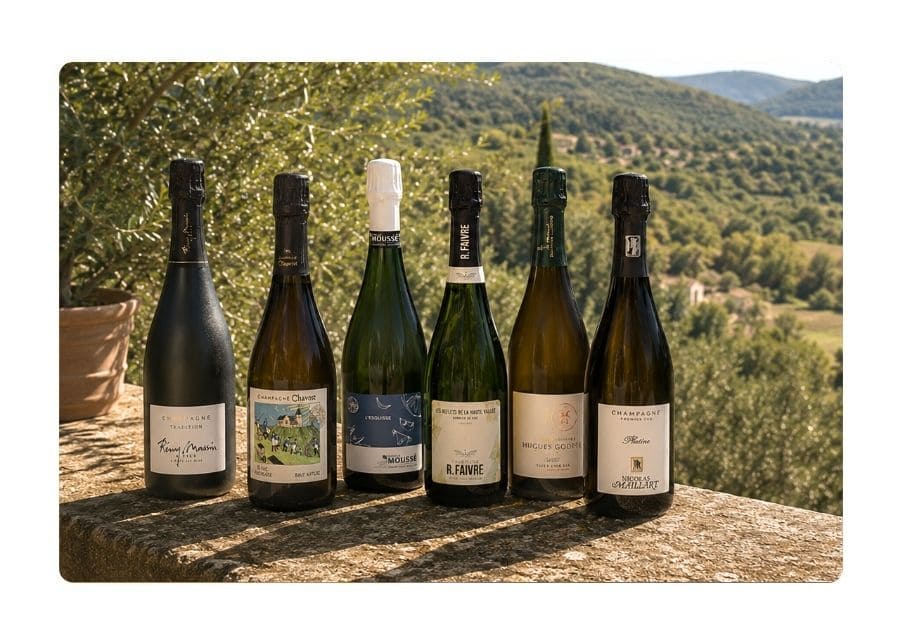
Likewise, certain Merchant-Producers (NM) such as Pierson Cuvelier or Nicolas Maillart craft remarkably fine cuvées far removed from industrial production.

Conversely, these same categories can also conceal large-scale operators focused on volume rather than quality.

This is where a specialist wine merchant plays a key role, acting as a filter. Their expertise and regular tastings help steer you towards authentic Champagnes with refined, balanced bubbles.

And there is no need to spend €50 to enjoy great Champagne quality can be found at far more accessible prices.

Styles of fine-bubble Champagnes

All the Champagnes we select feature elegant effervescence, though each style expresses finesse differently:

FAQ :

A Champagne with very small, regular and persistent bubbles forming a soft, creamy mousse.

Because the secondary fermentation is slower and ageing longer, allowing bubbles to refine over time.

They indicate careful cellar work, but overall quality also depends on dosage, terroir and vinification.

Blanc de Blancs, Extra-Bruts and long-aged Grand Crus.

At Champagne Terroir, where all Champagnes are sourced from independent growers selected for their precise effervescence.

Because of rushed secondary fermentation or insufficient ageing, preventing bubbles from refining. This cost-driven approach often results in heavily discounted Champagnes. In Champagne, as in many things, spending just a few euros more can dramatically change your experience.