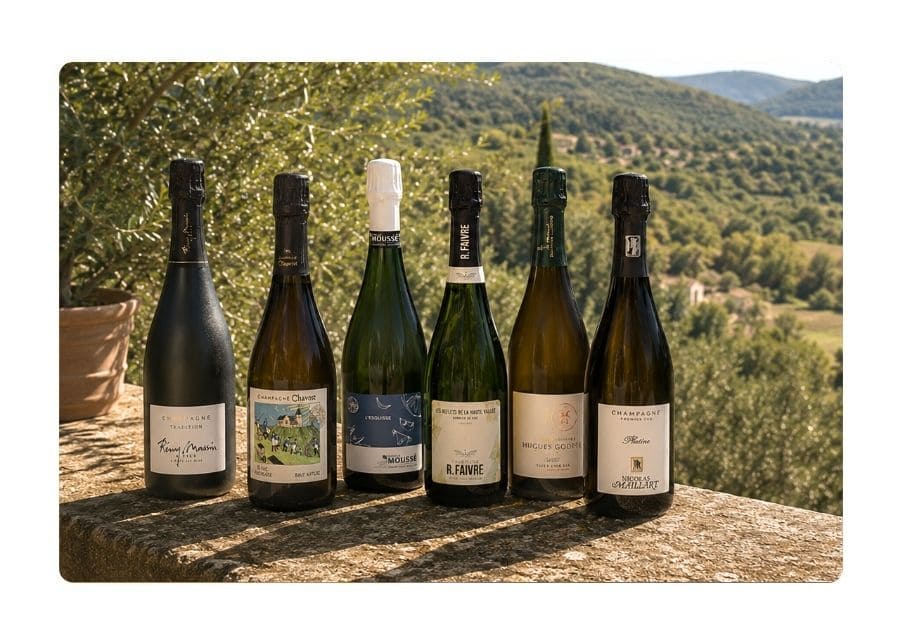
New ✨ Our Limited Edition boxes: Grand Cru, Blanc de Blancs and Blanc de Noirs
Contact us | Who are we ?
Language
Favoris
Cart
Brut, zero dosage, rosé de saignée, grower Champagne, négociant, Grand Cru… With so many terms, how can you choose a Champagne without being an expert?
This guide highlights the key essentials to help you confidently choose the right Champagne for every occasion.
Contrary to popular belief, choosing a Champagne is relatively simple. You can rely on these categories:
A Champagne’s style depends mainly on:
• dosage (sugar level)
• grape variety
• winemaking method
Dosage
• Brut : dry and balanced, the most common style.
• Extra-Brut / Zero Dosage: even drier, appreciated by lovers of mineral, tension-driven Champagnes.
• Demi-Sec: sweeter, ideal with dessert.
Grape varieties
• Blanc de Blancs: 100% Chardonnay, fine and fresh.
• Blanc de Noirs: from black grapes (Pinot Noir, Meunier), rounder and more structured.
• Rosé: fruity and vibrant.
Discreetly printed on every Champagne label, this mention is sometimes so small that you may never have noticed it. And yet, the legal status governing the production of the Champagne you are about to taste is clearly indicated on the bottle. Once again, Champagne stands out for its own specific legal framework. It must be said that the range of operators is vast, from small independent growers to multinational companies producing several million bottles per year — the spectrum is remarkably wide.
At Champagne Terroir, we select the best small grower Champagnes through tasting and vineyard visits.
In Champagne, the notion of “cru” refers to a classification of villages based on the quality of their terroir, historically established through the “échelle des crus” system.
• Grand Crus: only 17 villages out of more than 300 bear this prestigious designation. Among them are legendary terroirs such as Avize, Aÿ and Bouzy.
• Premier Crus: around 40 villages recognized for the quality of their grapes, just below the Grand Crus.
• Other villages, simply labeled Champagne, represent the majority of terroirs and offer extraordinary diversity.
While the mention “Grand Cru” or “Premier Cru” on a label is a mark of quality, it should not be forgotten that Champagnes from lesser-known villages can offer remarkable authenticity and excellent value for money.
Temperature: between 8 and 10°C to preserve aromas and freshness.
Glassware: inseparable from the Champagne tradition, the flute is generally the go-to glass for serving. However, enthusiasts often prefer a white wine tasting glass. While less visually striking for showcasing the bubbles, it allows for a much fuller expression of the wine’s aromas.
Storage: keep in a cool place, protected from light and temperature fluctuations. Remember that much of Champagne’s magic lies in its effervescence, created by carbon dioxide trapped inside the bottle. To preserve this effervescence for as long as possible, it is essential to prevent the cork from drying out. Simply store the bottle horizontally so the wine remains in contact with the cork.
Brut Champagnes are the style to favor. Offering the best balance between price and enjoyment, they are also designed to be convivial and appeal to the widest audience.
A dry Blanc de Blancs or a vintage Champagne pairs beautifully with aged cheeses.
It comes down to sugar dosage: Brut is dry, while Demi-Sec is sweeter, making it ideal for desserts.
Look at the regularity of the bubbles and the finesse of the mousse, but above all, trust your tasting experience and the producer’s reputation. If in doubt, choose a Champagne purchased from a specialized wine merchant (in your city or on Champagne Terroir) rather than one from large-scale retail.
Organic farming excludes synthetic chemical products. Biodynamics goes further by following lunar cycles and using natural preparations to strengthen the vines and enhance soil life.
Not necessarily more flavor, but often a purer, more expressive profile that better reflects the terroir and the vintage.
check_circle