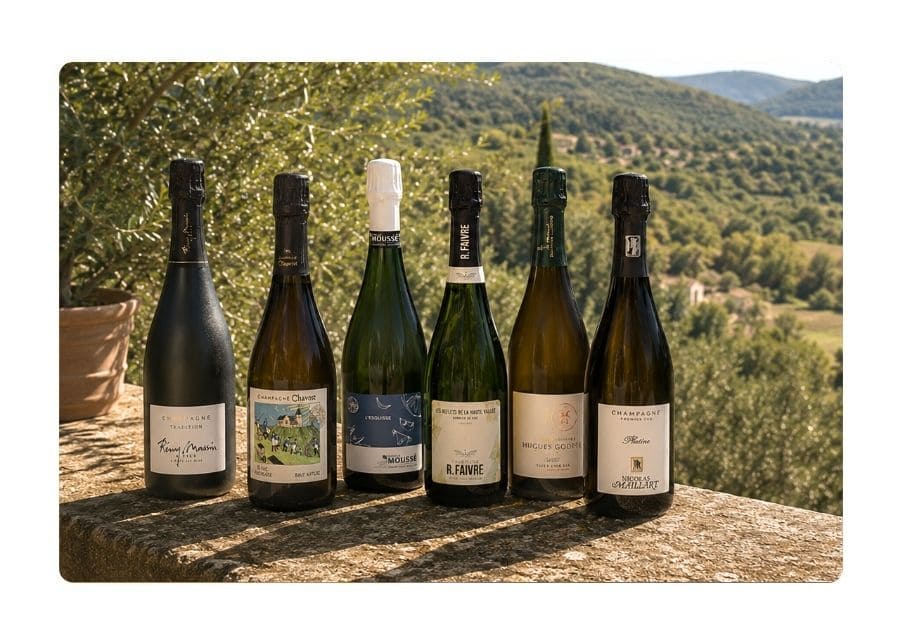
Exclusive ✨ Champagne Chavost, 100% no added sulphites at the Best Price
Contact us | Who are we ?
Language
Favoris
Cart
Filter By
Dosage level
Size
Region
Wine style
The right time
Classification
Blend type
Grape variety used
Accredited
There are 535 products.
Active filters
Zero dosage
Premier du Genre
Brut Tradition
Reserve Demi Sec
Juliette Grand Cru vintage 2020
"Chevaliers" Grand Cru blanc de blanc Brut Nature
Tradition Demi-Sec
Reserve
Réserve Grand Cru
Sensation 1er Cru
Signature Demi-Sec Cuvee
In Champagne, dosage consists of adding a liqueur d’expédition made from wine and sugar after disgorgement, when the yeast deposit formed during secondary fermentation is removed. This final addition determines the level of residual sugar in the Champagne and therefore its taste profile, from the driest styles such as Brut Nature to the sweeter styles like Demi-Sec or Doux.
The addition of liqueur d’expédition is a defining feature of the Champagne method.
It is made from Champagne wine and carefully selected sugar. Traditionally, cane or beet sugar was used, but today some producers prefer MCR (rectified concentrated must), which is grape juice with the water removed. This choice allows sweetness to be added while remaining fully consistent with the product, since only elements derived from the vine are used.
The liqueur is added with great precision, as just a few grams of sugar per litre are enough to move a Champagne from Extra-Brut to Brut or even Demi-Sec.
This process is a true Champagne signature and is rarely applied with such precision in other sparkling wines.
Dosage was originally developed to balance the natural acidity of Champagne wines. Champagne is the northernmost wine region in France, even cooler than Alsace, and grapes were historically harvested with high acidity.
Adding sugar helped soften this sharpness while bringing roundness and balance. Sugar also played an essential technical role, acting as a natural preservative at a time when cellar hygiene and bottle quality were far less reliable than today.
With climate change, grapes now reach far greater ripeness. Natural acidity has decreased, producing richer, rounder wines. As a result, dosage levels have fallen dramatically. While Demi-Sec styles dominated in the 1980s, they are now rare. Today, Brut Champagnes are often closer to 6 g/L than the 12 g/L common in the past. Extra-Brut styles are increasingly widespread, and Brut Nature cuvées, with no added sugar, are now produced by both leading growers and prestigious Champagne houses.
Compared with other sparkling wines, Italian Prosecco averages between 12 and 20 g/L, Spanish Cava between 6 and 12 g/L for a Brut, and Asti, naturally sweet, often exceeds 50 g/L. Champagne has therefore pushed the pursuit of finesse and low dosage further than any other sparkling wine region.
Officially, the Champagne Committee defines Brut as any Champagne containing between 0 and 12 g of sugar per litre. Technically, Brut Nature (Zero Dosage), Extra-Brut and classic Brut all fall under this category.
In practice, however, producers and wine merchants distinguish three styles:
- Brut Nature or Zero Dosage: 0 to 3 g/L
- Extra-Brut: 3 to 6 g/L
- Classic Brut: 6 to 12 g/L
This is also the approach we take at Champagne Terroir, as it better reflects the true diversity of available cuvées.
Dosage has a direct impact on the style and perception of a Champagne. For a ceremony, wedding or large reception, Brut remains the safest choice, as its balance and roundness appeal to the widest range of palates.
Brut Nature and Zero Dosage Champagnes stand out for their aromatic purity, freshness and minerality. They are often chosen by experienced drinkers who enjoy dry, precise wines. These cuvées express terroir without the softening effect of sugar but require a more developed tasting sensitivity.
Extra-Brut represents an ideal compromise. Drier than a classic Brut, it retains a subtle touch of sweetness that adds roundness and makes it more accessible than a Brut Nature.
Dosage plays a key role in food pairings, but the Champagne style matters just as much.
Blanc de Blancs, made exclusively from Chardonnay, offer mineral tension and freshness that shine with low dosage. They pair beautifully with seafood, oysters and delicate fish.
Blanc de Noirs, made from Pinot Noir and Meunier, are more structured and vinous. In Brut or Extra-Brut, they match perfectly with poultry, white meats and even lightly spiced dishes.
Classic blends combining Chardonnay, Pinot Noir and Meunier strike a balance between freshness and roundness. In Brut, they are ideal as an aperitif or throughout a festive meal.
Rosé Champagnes, whether blended or saignée, are defined by their fruit-forward profile. In Brut, they pair wonderfully with Mediterranean cuisine, grilled dishes or red-fruit desserts. In Demi-Sec, they become true dessert Champagnes, perfect with strawberry tart or chocolate fondant.
Dosage is the addition of a liqueur d’expédition made from wine and sugar after disgorgement. It balances the wine and defines its style, from the driest to the sweetest.
Historically, it was used to soften Champagne’s natural acidity and improve preservation at a time when cellar conditions were less reliable.
Brut officially ranges from 0 to 12 g/L, but in practice Brut Nature (0–3 g/L), Extra-Brut (3–6 g/L) and Brut (6–12 g/L) are distinguished, followed by Extra-Dry, Sec, Demi-Sec and Doux.
Extra-Brut contains less sugar (3–6 g/L) than Brut (6–12 g/L) and is therefore drier and more vibrant.
Brut is the most versatile. Brut Nature suits experienced drinkers who enjoy very dry styles.
Demi-Sec or Doux pair perfectly with sweet desserts thanks to their roundness and sweetness.
Yes, but with less strict definitions. Prosecco is often more dosed (12–20 g/L), Cava is closer to Champagne (6–12 g/L for Brut), and Asti is naturally sweet, often above 50 g/L.
check_circle