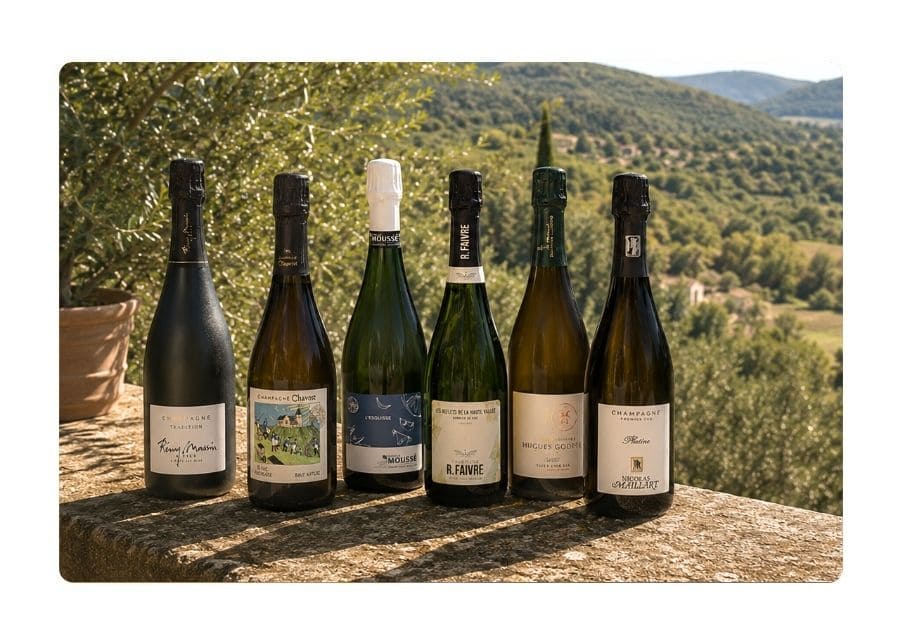
Exclusive ✨ Champagne Chavost, 100% no added sulphites at the Best Price
Contact us | Who are we ?
Language
Favoris
Cart
If there is one grape variety that everyone knows, it is undoubtedly Chardonnay. An emblematic and globally renowned grape, it is behind the finest Blanc de Blancs Champagnes and some of the most celebrated white wines from Burgundy.Highly appreciated by consumers for its aromatic profile, reliability, and prestigious image, it is equally valued by winemakers for its versatility, its ability to express its terroir, and its ease of cultivation. Thanks to its many qualities, Chardonnay has become the second most widely planted white grape variety in the world and one of the most consumed.
Chardonnay first took root in Burgundy, where it originated from a crossing between two grape varieties: Pinot Noir and Gouais Blanc. Appreciated for its sensory qualities, it gradually spread across several French and European regions before becoming an internationally recognized grape variety in the 20th century.
Today, Chardonnay is grown not only in Burgundy and Champagne, but also in regions such as Languedoc-Roussillon, the Loire Valley, Savoie, Beaujolais, and Jura. And its reach extends far beyond Europe, thriving across most continents: California, Chile, South Africa, Australia, New Zealand… It now covers more than 200,000 hectares worldwide, making it the second most widely planted white grape variety.
Chardonnay is an extremely versatile grape variety with a remarkable ability to reflect its environment. Depending on the climate and terroir where it is grown, it produces very different styles of wine:
• In cool climates such as Burgundy or Champagne, it produces wines that are crisp, precise, and mineral-driven.
• In temperate to warm climates, it yields rounder, fruitier wines, sometimes with exotic notes.
This diversity is also reflected in winemaking:
• Aged in stainless steel tanks, it retains its natural aromas, expressing great finesse and freshness, offering a pure expression of its terroir.
• Aged in oak barrels, it becomes more powerful, with greater aromatic richness. On the palate, it reveals woody, buttery, or brioche notes.
Chardonnay can therefore express itself in almost every style of white wine: dry, age-worthy, or sparkling, offering great freedom to both winemakers and wine lovers.
In Champagne, Chardonnay accounts for 31% of the vineyard, representing more than 10,200 hectares. An emblematic grape of the Côte des Blancs, renowned for producing the finest Blanc de Blancs, it thrives on chalky, limestone-rich soils that allow it to develop refined and aromatic grapes. This exceptional terroir is home to six villages classified as Grand Cru, recognized for the quality of their soils and the potential of their grapes.
Champagnes made from this grape variety are distinguished by their delicate aromas, with floral notes (white flowers, hawthorn, acacia), citrus (lemon, grapefruit), white fruits (apple, pear), and sometimes mineral nuances (chalk, flint). Thanks to its natural acidity and structure, Chardonnay gives wines great aging potential, allowing them to gain complexity and finesse over time.
Often served as an aperitif or with dessert, sometimes mistakenly, Blanc de Blancs can accompany an entire meal, provided the right pairings are respected. Its freshness and liveliness require careful balance: if poorly matched, it can either fade or overpower the dish.
To achieve the perfect balance, a few simple guidelines can be followed.
For the aperitif, a Brut, thanks to its fine bubbles and freshness, is best enjoyed on its own or with delicate appetizers.
For starters, an Extra-Brut or Brut Nature Blanc de Blancs pairs perfectly with seafood or fish-based dishes: oysters, shellfish, smoked salmon, rillettes, or tartares. It can also enhance simple starters with subtle flavors.
For main courses, more structured Blanc de Blancs (thanks to extended aging on lees, oak aging, or a warmer vintage) pair perfectly with white fish, shellfish, or poultry, offering aromatic richness and length on the palate.
For dessert, it is best to avoid overly sweet or heavily chocolate-based dishes, which could overpower the finesse and freshness of the champagne. Instead, opt for fruit-based desserts such as pavlova or lemon meringue pie. That said, this is still a champagne best enjoyed at the beginning of the meal.
Not necessarily. The grape naturally brings freshness and tension, but the final style depends on the dosage, the terroir, and the winemaking.
A Blanc de Blancs is made exclusively from white grape varieties, mainly Chardonnay in Champagne. A “classic” Champagne is typically a blend of Chardonnay, Pinot Noir, and Pinot Meunier, offering a broader and more vinous profile.
No. While it is highly appreciated as an aperitif, Chardonnay Champagne can accompany an entire meal. The more structured or vintage champagne are particularly well suited to fish, shellfish, and poultry dishes.
For an aperitif, opt for a fresh and crisp Blanc de Blancs. For a meal, choose a more mature cuvée with extended aging or some oak influence. For a gift, a Blanc de Blancs from the Côte des Blancs or classified as Premier or Grand Cru is a safe choice.
Yes. Thanks to its natural acidity, Chardonnay gives Champagnes excellent aging potential. Over time, they gain complexity, developing brioche, toasted, and more evolved notes.
Yes, especially in its Brut style. Its finesse, freshness, and balance make it an excellent entry point into the world of Champagne, while still being highly appreciated by experienced enthusiasts.
check_circle